Six Habits To Heal Your Lumbar Disc Injury.
Lumbar disc injuries (bulges, prolapses, annular tears) do heal without surgery in the majority of cases , it just takes a little while. This blog covers some simple things you can do at home to help your low back disc injury heal. It’s more aimed at the rehab stage of healing following a diagnosis of a disc problem, not the first 1-3 days after the initial painful (acute) flare up.
Common symptoms of a low back disc injury include;
Low Back Pain: Aching, stiff, or sharp pain in the lower back, often worse when sitting, bending, or lifting.
Leg Pain or Tingling (Sciatica): Pain, burning, or pins-and-needles down one or both legs.
Numbness or Weakness: Sometimes your leg or foot may feel weak or numb.
Movement Difficulty: Trouble bending, lifting, standing, or walking for long periods.
Disc injuries are best diagnosed using MRI scans, although your signs & symptoms can sometimes lead to a clinical diagnosis from a healthcare professional like a GP, osteopath or chiropractor. If your symptoms include loss of bladder or bowel control, numbness around your inner thighs or bottom, or sudden leg weakness, then you should seek medical care immediately to rule out Cauda Equina Syndrome.
Discs do heal - just slowly.
Intervertebral discs cushion the bones of your spine, with a soft gel center (nucleus pulposus) and a tough outer ring (annulus fibrosus). Unlike muscle or skin, discs have very limited blood supply, so nutrients and oxygen reach them slowly, making healing inherently slower — but recovery and symptom improvement still happen (1).
Most people with lumbar disc herniation improve without surgery. A recent study showed that 70-80% of injured discs heal by ‘spontaneous resorption’ within 6 months (2). Another study showed that most people avoid surgery and experience disc shrinkage and symptom improvement within 9 months (3). Some people can even resolve their disc injuries (with complete radiographic resolution) within 3 months with targeted motor-control exercises (4).
While outcomes vary by herniation size and type, these studies confirm that only a minority require surgery, and meaningful improvement often occurs within weeks to months when conservative strategies are applied (2,3,4).
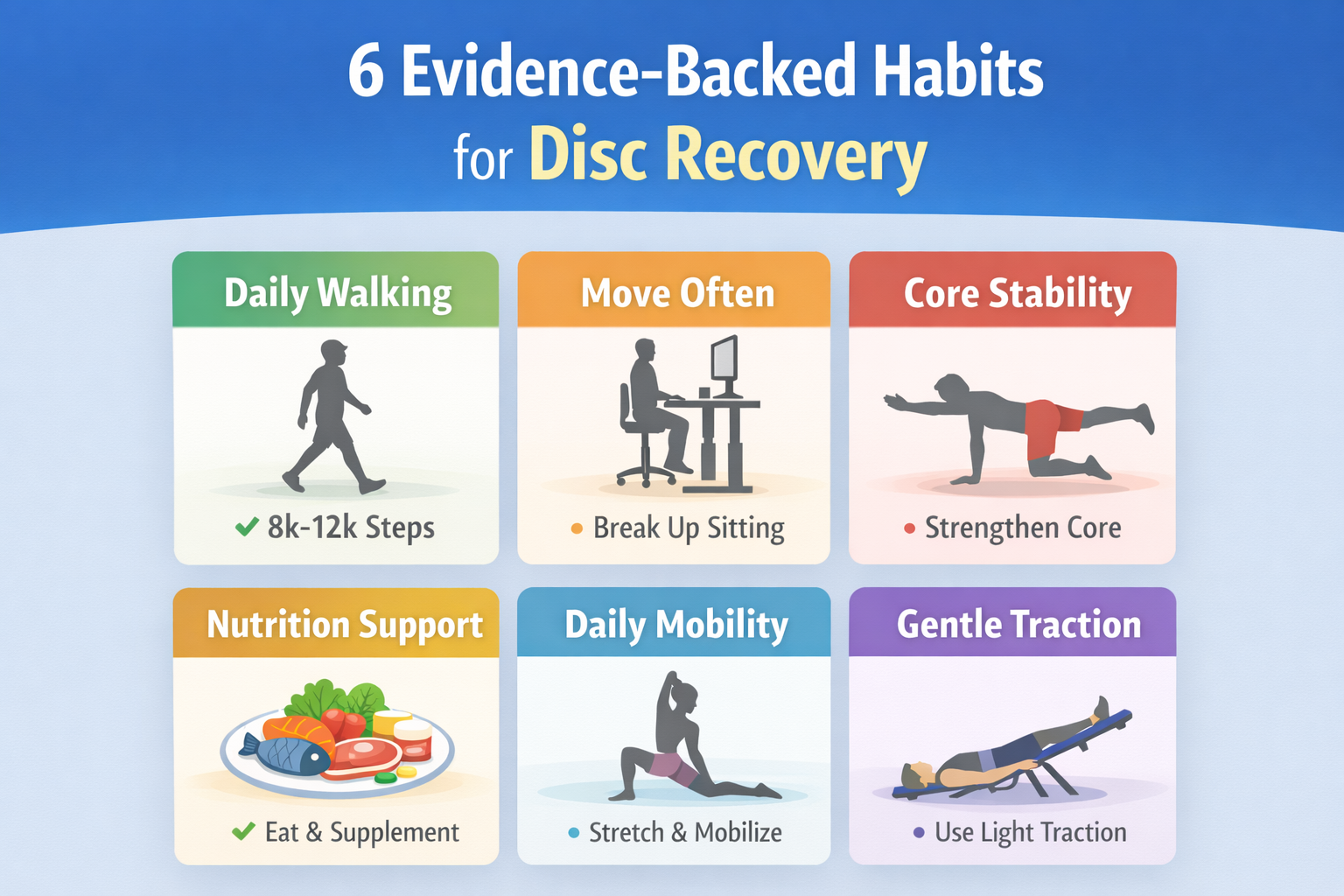
Six evidence backed habits for disc recovery
Recent research has highlighted six habits you can adopt to help your lumbar discs recover from injury.
Please note, depending on how recent or severe your low back disc injury is, you may not be able to perform some or any of these exercises. If you are unsure about which exercises to do, then don’t attempt them and please consult a doctor or back pain specialist (osteopath, chiropractor) to get some advice first.
1️⃣ Walk.
Exercise is one of the most consistently effective conservative strategies for lumbar disc herniation. Reviews of recent clinical evidence show that exercise interventions — including walking and motor‑control exercises — reduce pain and improve function, likely by increasing circulation and nutrient exchange in spinal tissues (5).
Try this:
✔ Walk 8,000–12,000 steps per day, broken into comfortable segments
2️⃣ Minimize sitting time.
Prolonged sitting increases mechanical pressure on lumbar discs and is linked with early signs of degeneration and discomfort, while frequent posture changes reduce those stresses (6). World spine consensus guidelines emphasize starting with activity modification and physical therapy as first‑line treatment for disc herniation (7).
Your practice:
✔ Stand or walk for 3–5 minutes every 30–45 minutes of sitting
✔ Use a sit‑stand desk or breaks during sedentary activities
3️⃣ Build up your core.
Targeted core training helps stabilize your spine and reduce abnormal forces on a healing disc. Recent reviews highlight that specific exercise programs (motor control and neurodynamic mobilization) have the strongest evidence among exercise options for disc herniation (5).
Try daily:
Bird Dogs: 10 slow reps per side
Side Planks: 20–30 sec/side
Glute Bridges: 12–15 controlled reps
Dead Bugs: 10 controlled reps
4️⃣ Optimize your nutrition.
Having good vitamin D levels is very important as multiple studies have shown vitamin D is needed for good general health and to slow disc degeneration (9). Taking regular Vitamin D3 supplements will help you achieve this. Ideally you should monitor your vitamin D blood levels to make sure they are not too high, but taking a maximum daily amount of 4,000 IU is now regarded as safe for most people by medical authorities (10). The main issue with taking too much vitamin D is the possible build up of calcium into the blood. This is very rare , but anyone with a calcium-related health issue should speak with their GP before supplementing with vitamin D.
Recent research suggests that some supplements may help stabilize disc health and support structural tissue around the spine. A trial testing a supplement with collagen type II, hyaluronic acid, n‑acetyl‑glucosamine, L‑lysine, and vitamin C in people with lumbar osteochondrosis found around a 13% increase in 3D disc volume on MRI compared to placebo over 3 months, along with trends toward functional benefit (8).
Simple dietary steps:
✔ Ensure your vitamin D levels are good (30–50 ng/mL range). Your GP should be able to test this for you.
✔ Consider a connective‑tissue supplement with the ingredients shown above. You can source some or all of the ingredients separately, or consider a product like vertebene which has most of them already combined in one product. I have covered some of the supplements I like in this article.
5️⃣ Improve your spinal mobility.
Gentle daily mobility improves spinal flexibility and reduces stiffness. Recent narratives and clinical evidence emphasize neuromuscular control exercises as essential parts of conservative therapy (5). I cover some other spinal mobility exercises in this article here.
Routine (~10 minutes):
✔ Cat‑Cow: 10–12 reps
✔ Pelvic Tilts (lying): 15 reps
✔ Child’s Pose: 30–45 sec hold
✔ Hip Flexor Stretch: 30–45 sec/side
6️⃣ Try low back traction
Traction techniques such as using an inversion table or gentle hanging by your arms (dead-hanging) are part of conservative care approaches. Inversion tables are definitely worth trying, you can often pick up used ones very cheaply on Ebay. Recent spine reviews include traction alongside physical therapy modalities that may help reduce pain and disability compared with no intervention (7). Read my article here for more about traction exercises for your low back, including the use of gravity boots for hanging totally upside down!
Safe use tips:
✔ Start with short sessions (30 sec–2 min)
✔ Stop if symptoms increase
✔ Avoid full inversion if you have heart or blood pressure issues
This information is for educational purposes only and is not a substitute for professional medical advice. Always consult a qualified healthcare professional for diagnosis, treatment, or questions about your specific condition.
Cliff Russell , Registered Osteopath @ Osteo Studio
Research References
Zhao Y, Jia Z, Aili A, Muheremu A. Mechanisms and management of self‑resolving lumbar disc herniation: bridging molecular pathways to non‑surgical clinical success. J Orthop Surg Res. 2025;20:528. DOI:10.1186/s13018‑025‑05959‑x.
Zou T, Liu X‑Y, Wang P‑C, et al. Incidence of spontaneous resorption of lumbar disc herniation: a meta‑analysis. Clin Spine Surg. 2024;37(6):256‑269. DOI:10.1097/BSD.0000000000001490.
Shen X, Yu P, Shao Y, et al. Value of contrast‑enhanced MRI for predicting resorption of ruptured lumbar disc herniation: a prospective study of 82 cases. J Orthop Surg Res. 2025;20:1006. DOI:10.1186/s13018‑025‑06411‑w.
Novak MJ, Jeffree RL. Spontaneous resorption of herniated lumbar discs: illustrative cases. J Neurosurg Case Lessons. 2025;10(3):CASE24873.
Arslan S, Ülger Ö. The effect of exercise in the treatment of lumbar disc herniation: a systematic review. Acta Neurol Belg. 2025;125(5):1209‑1224. DOI:10.1007/s13760‑025‑02767‑2.
Lumbar disc herniation reabsorption: clinical manifestations, mechanisms, and conservative treatments. Front Med (Lausanne). 2025;12:1633762. DOI:10.3389/fmed.2025.1633762.
Yaman O, Guchkha A, Vaishya S, et al. The role of conservative treatment in lumbar disc herniations: WFNS spine committee recommendations. World Neurosurg X. 2024;100277. DOI:10.1016/j.wnsx.2024.100277.
Laky B, Huemer D, Eigenschink M, et al. A dietary supplement in the management of patients with lumbar osteochondrosis: a randomized, double‑blinded, placebo‑controlled study. Nutrients. 2024;16(16):2695. DOI:10.3390/nu16162695.
Peng Wang et al. J Orthop Transl. 2023;40:13-26. doi:10.1016/j.jot.2023.04.003
Zittermann, A., Trummer, C., Theiler-Schwetz, V., & Pilz, S. (2023). Long-term supplementation with 3200 to 4000 IU of vitamin D daily and adverse events: a systematic review and meta-analysis of randomized controlled trials. European Journal of Nutrition, 62(4), 1833–1844. doi:10.1007/s00394-023-03124-w