Along with having a hip problem myself, I see a lot of patients who are in the early stages of arthritis in one of their hips. They often come in complaining of pain over the hip itself, or sometimes into the groin, knee, or back. They usually feel worse with longer walks, climbing stairs and can classically struggle to tie their shoelaces on the bad side.
Hips like this are in the early stages of the breakdown of the cartilage layer between the bones of the ball and socket joint (the femur and the pelvis).
You can usually pick up these changes in terms of a loss of hip movement, and if required they can be confirmed with a simple x-ray.
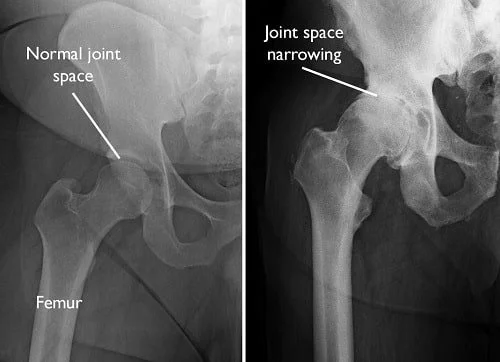
Normal versus Arthritic Hip Xray
The image on the left shows an Xray of a normal right hip. There is a line pointing to the ‘normal joint space’ . This area of dark colour is the layer of cartilage between the ball of the femur and the socket of the pelvis.
In the image on the right, which is an Xray of an arthritic right hip, you can see that there is a line pointing to ‘joint space narrowing’ where this layer of cartilage is much thinner.
If you have a hip like this, you are not really suitable for a hip replacement, as these surgeries are normally reserved for people with much more advanced joint damage.
So, what can you do when you are still suffering quite a lot in terms of pain and reduced mobility?
Mainstream Approaches
For UK-based readers, your GP will typically start by offering you anti-inflammatory medications. These will usually be medications like diclofenac (gel or tablet form), ibuprofen, or naproxen. These may help with pain, but often come with side effects and don’t address some of the problems I will cover later.
The other thing you may be offered is a steroid injection. There is 2025 research to show that these injections can provide meaningful short-term pain relief and functional improvement, but the effect tends to diminish over time, with benefits generally measured in weeks to a few months rather than years.
In my opinion, a steroid injection is definitely worth trying as one study in 2016 showed that 50–70% of patients reported worthwhile pain relief after a steroid injection for their hip arthritis.
There are also other interventions, mainly available privately in the UK, that are shown to have some benefit to people with hip arthritis. These include;
Research has shown that there is often some value to each of these procedures, but they can be expensive and results can vary a lot from person to person. Importantly, barring certain surgical approaches, none of them have been shown to regenerate damaged cartilage.
For more information about the different approaches, click on the hyperlinks which will take you to the most recent review of their effectiveness.
So what can you do yourself?
I’m now going to cover 4 things you can do at home for little or no cost which will help to improve your hip pain and function. All of my suggestions are based on scientific research, and I will include links to research papers if people want to learn more.
1. Drop your bodyweight 5%
Research in 2025 has shown that losing as little as 2.5 % to 5 % of your bodyweight can produce noticeable pain reduction, easier walking and less of a limp in people with hip arthritis. So for an 80 kg person, this means a loss of between just 2 to 4 kg.
Whilst the more weight you lose the better, even a small weight loss can reduce inflammation in your body and significantly reduce the amount of force going through your hip when you walk.
How you lose this weight is beyond the scope of this article, but along with traditional calorie restriction approaches I would encourage people to look at things like gentle increases in exercise volume, intermittent fasting, and low carbohydrate diets.
2. Change the way you walk.
Recent research has shown that if people can alter the way they walk (gait retraining) then they can reduce the forces that go through their hips with each step.
When people with arthritic hips overstride (take longer steps) their hips spend more time under high load each step. To combat this, you should look to take smaller steps but walk at a higher cadence - taking slightly more steps per minute.
Ideally, this retraining would be done with the help of specialists who use treadmills and metronomes to help you recalibrate your walking cadence, but there is nothing wrong with trying to gently adjust your own gait at home.
If you get it right, it will feel slightly easier when you walk. If it’s not feeling easier then stop and get some specialist advice before continuing.
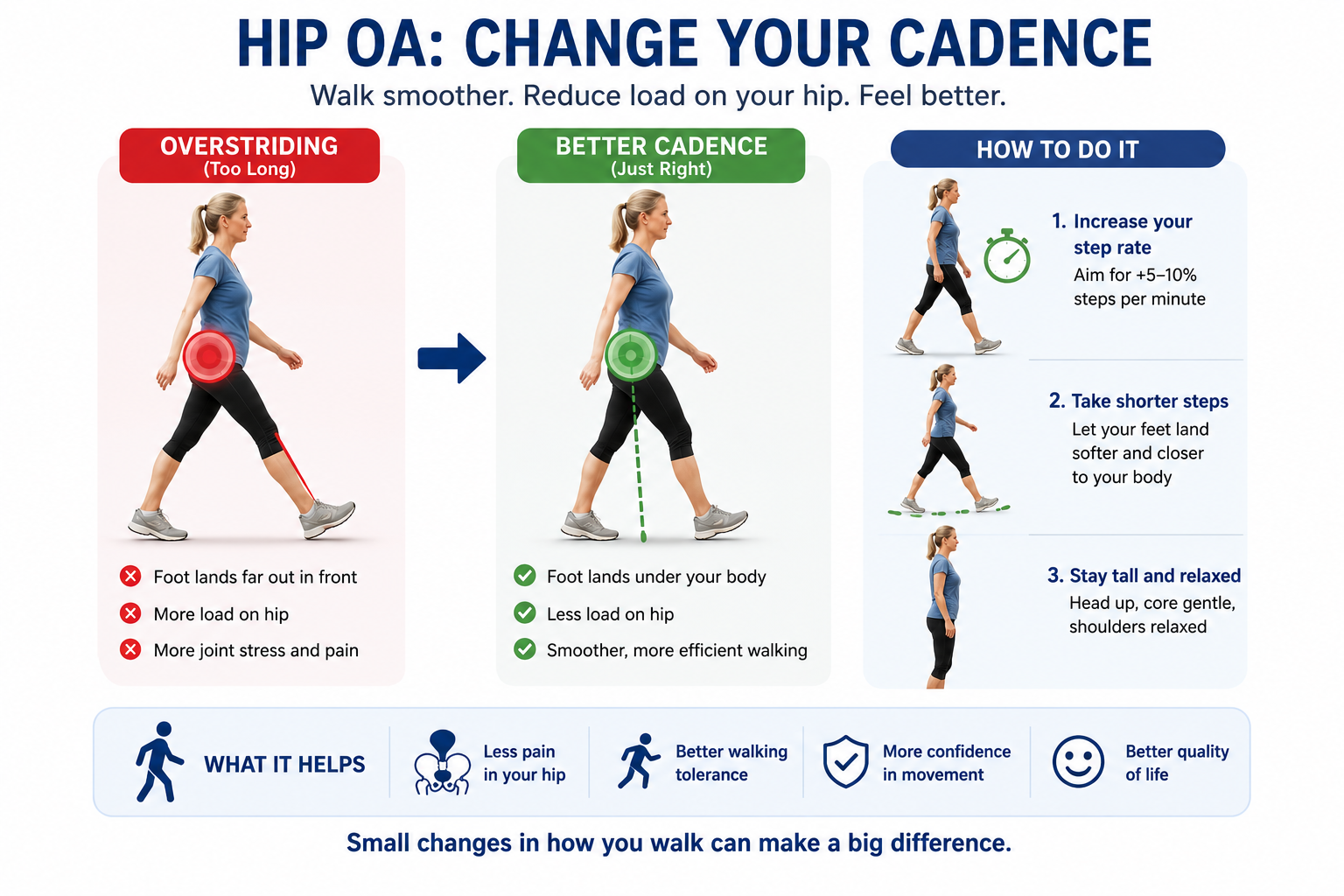
For those wanting to have a go at altering their walking cadence, this infographic shows how you should try to keep upright and relaxed and walk with slightly quicker steps thinking: “short steps, feet under me”.
Improving your walking cadence.
3.Strengthen your hip muscles
Research has shown that a number of different hip and leg muscles become weak when people develop an arthritic hip. With hip arthritis people naturally try to avoid putting weight through the affected joint, which then leads to muscles ‘switching off’ and becoming weaker with time.
The most important muscle affected by hip arthritis is gluteus medius, which I’ve written about before here.
Weakness in this muscle happens early on with hip arthritis and contributes to the limping seen with arthritic hips. Another muscle that has been shown to weaken with hip arthritis is gluteus maximus, the large buttock muscle responsible for powering your hip backwards during the walking cycle.
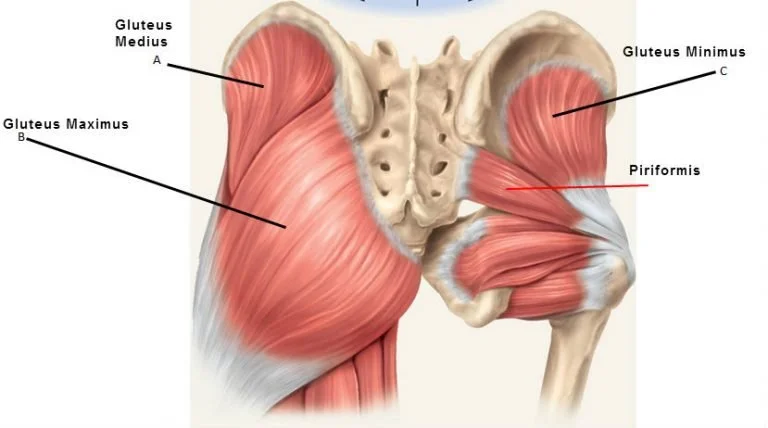
Gluteus medius (A) and gluteus maximus (B)
Both muscles become ‘switched off’ and weaker with hip arthritis. The other two muscles shown, Gluteus minimus (C) and piriformis (D) also become weaker.
Below are some different exercises for strengthening these two key muscles, in some cases also working other muscles in the process.
Side Lying Hip Abduction for Gluteus Medius
Side Lying Hip Abduction for Gluteus Medius. Do 3 sets of 12 repetitions each side.
Standing Hip Abduction for Gluteus Medius
For people who might struggle with doing the last exercise on the floor, there is a standing version.
Standing Hip Abduction for Gluteus Medius. Do 3 sets of 12 repetitions each side.
Glute Bridges for your Gluteus Maximus
Glute Bridges for your Gluteus Maximus.
Standing Gluteus Maximus Exercise
Below is the standing version of the glute bridge for people who can’t easily do the floor version. Again, three sets of 12 repetitions for each leg.
Standing Gluteus Maximus Exercise
Hip Step Ups
Step ups are a mainstay of rehab protocols for arthritic hips, as they work on a number of key leg and hip muscles. To start with, only use a low step that is comfortable for you and don’t use any extra weight. You should look to do 3 sets of 12 step ups for each leg, and do this no more than 2 or 3 times a week.
Please note, some people might find this exercise uncomfortable. Research has shown that it’s ok to have mild discomfort during this exercise, provided that the symptoms settle by the next day and do not produce a sustained flare.
Hip Step Ups
4.Consider switching from glucosamine to other supplements.
For many years, glucosamine has been the go-to supplement for people looking to help their arthritis, and over the years I’ve had many patients who believe that it has helped them.
Whilst there is still some evidence of benefit, recent research has shown that it is probably minimal. A 2018 study in the British Medical Journal concluded “Widely used supplements such as glucosamine and chondroitin were either ineffective or produced only small, clinically unimportant effects“. Previous large studies have also come to similar conclusions.
Whilst this might be disappointing for glucosamine users, all is not lost, as it turns out that there are other inexpensive natural supplements that may offer better results than glucosamine.
Based on recent research, I have picked out below four of the most promising supplements that have demonstrated benefit in relation to osteoarthritis. If you want to look at some of the research, just click on the links.
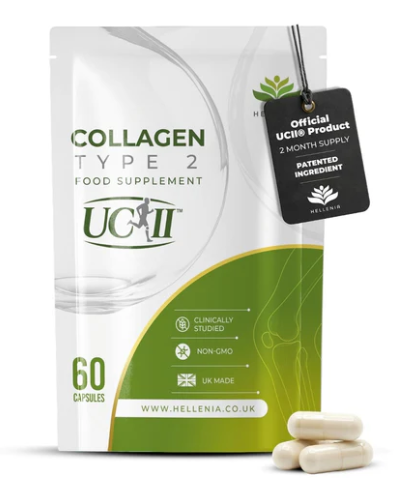
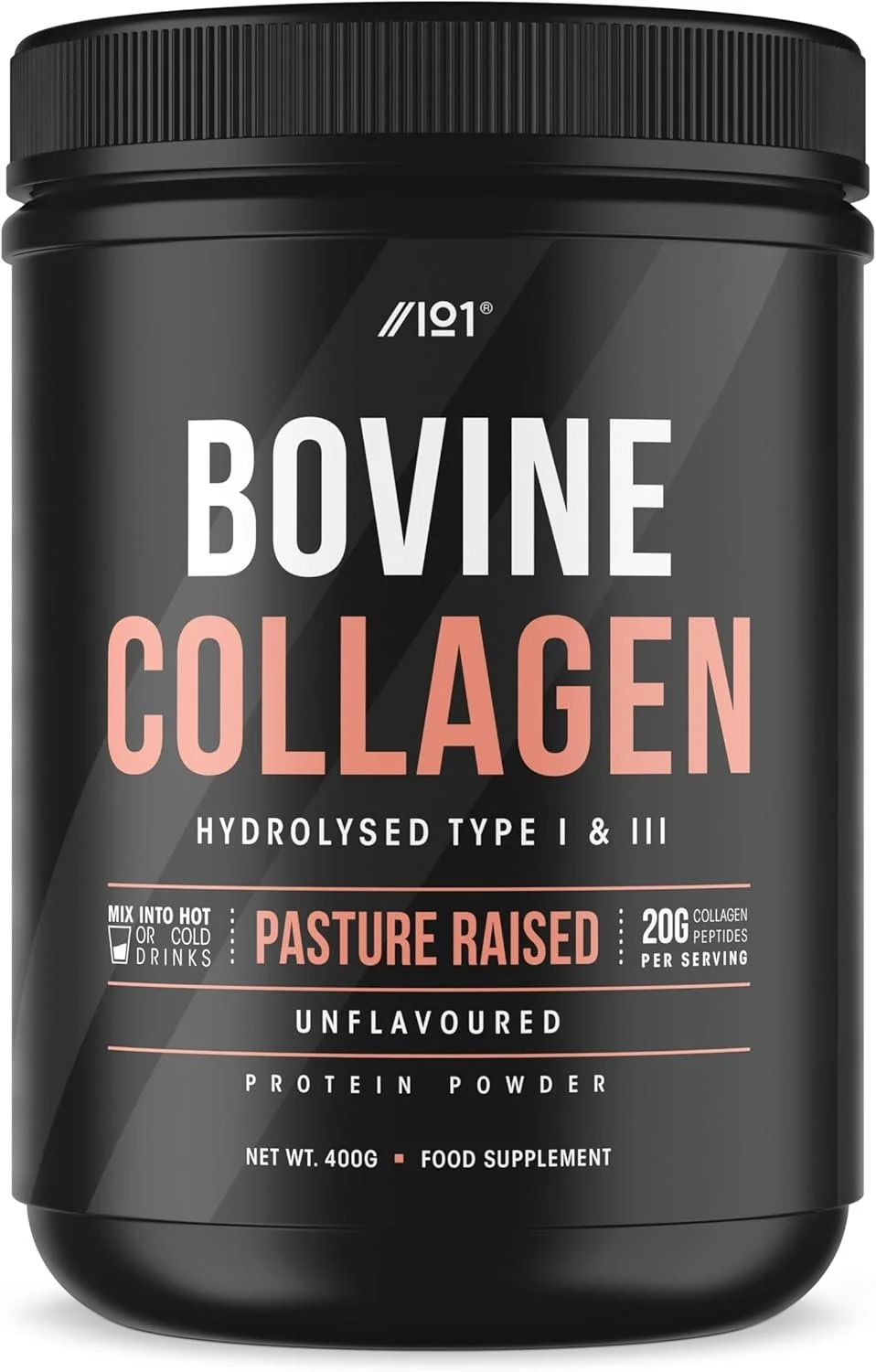
Collagen peptides (hydrolyzed collagen) or Undenatured type II collagen (UC-II)
The table below shows the suggested daily dose for each supplement and a quick summary of the research supporting it.
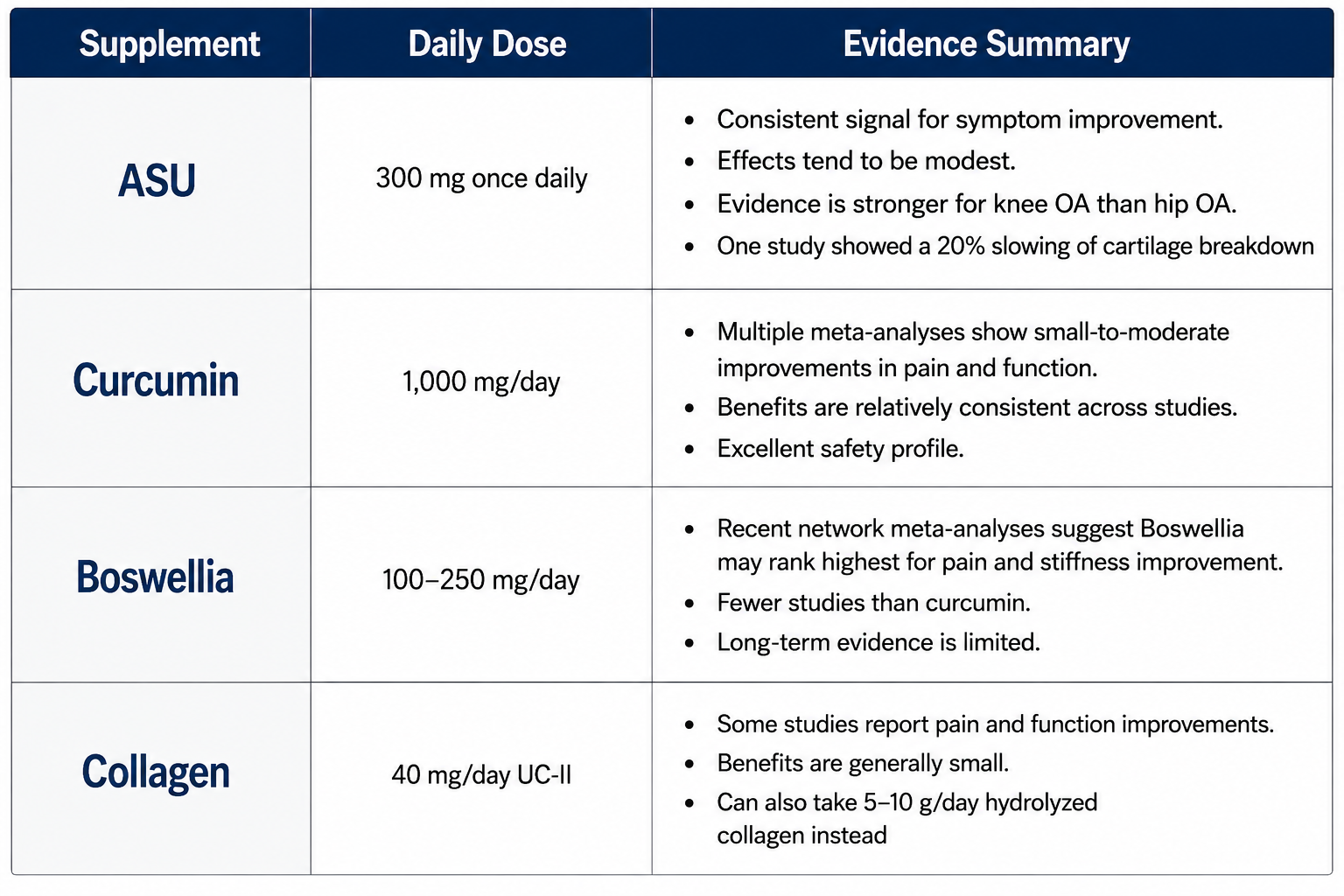
4 Supplements that can help with hip arthritis.
It’s worth pointing out that most of the research has come from looking at knee arthritis, with the benefits then being assumed to also apply to hips.
In my opinion, I think it’s reasonable to expect that a supplement that helps knee arthritis could also do the same for hips. Both joints are suffering with similar processes of cartilage breakdown and inflammation.
It’s also worth noting that no supplement has yet been shown to reverse cartilage damage, instead their benefits are from reduced pain and increased function.
If you are interested in trying these supplements, I would encourage you to do your own research into what’s available. At the moment, it appears that nobody is offering a combined product containing all four compounds.
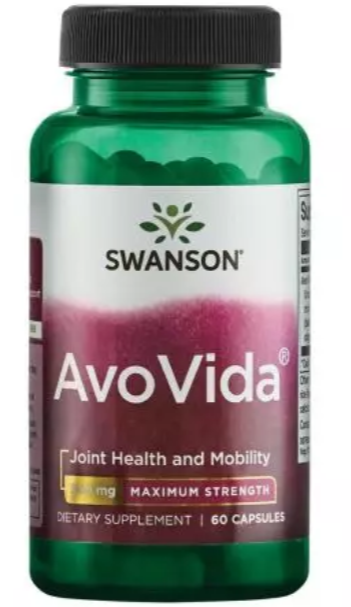
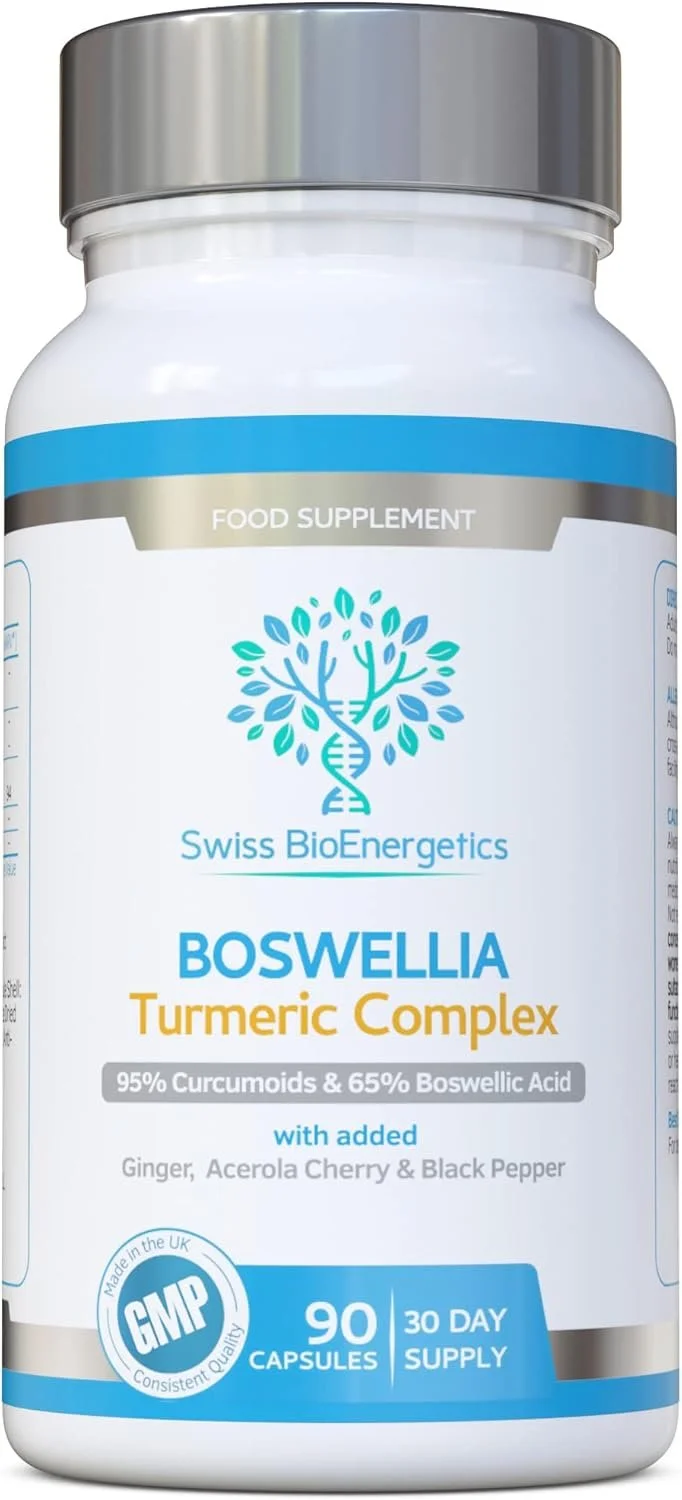
For those of you who need a quick point in the right direction, here are some examples of products currently available in the UK. Note, with the collagen you have a choice of the powder, or the more concentrated Type II capsules.
If you are on a tight budget, then based on research evidence, I would probably prioritize the curcumin with or without the Boswelia.
Cliff Russell
Registered Osteopath @ Osteo Studio