Every osteopath has a different treatment approach, and mine is often to focus on symmetry (or rather the lack of it) in my patients bodies. This article will talk about how I spot asymmetry, what it might mean, and what you can do about it. You can use the same information to check your own body for asymmetries and if it’s causing you problems, do something about it.
First off, it’s perfectly normal to have some degree of asymmetry in your body, and for most people little differences don’t really cause a problem as the body is perfectly capable of compensating for them. The classic example is leg length differences, which I’ve written about in detail in a previous blog here. It’s been estimated that only around 10% of people have perfectly equal leg lengths, with the rest mainly having minor differences under 1cm.
These small leg length differences are usually well tolerated when people are young, but can become problematic later on in life when the body is less able to compensate. Large leg length differences (1cm+) can be problematic at any age, and are often present in patients who complain that their back feels out.
So what are some of the things I look for in my patients?
I start by having a look at my patients standing, and see if their shoulders and pelvis are the same level. You can do this yourself by just looking at yourself in the mirror.
Whilst looking for images for this article I came across this gentleman. The lines have been added by me, and they show that both his shoulders and pelvis are not level. Although it’s not possible to tell with certainty, he probably has a shorter left leg which is causing his pelvis to drop to the left side.
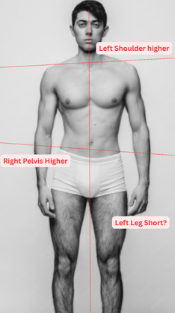
Although I don’t know if he has back pain, because of the asymmetry present, I suspect that there is a lot of extra strain going through his back. Because his right pelvis is higher, the base of his spine is not level, and is tipped over to the left slightly.
As people generally don’t like walking around tipped over to one side, his body then has to compensate and straighten itself up. He actually ends up over-compensating and bending too far to the right, leading to his left shoulder being higher than the right. If you look closely, you can see that the space between his right arm and his body is smaller than the equivalent space on the left, another indication that he’s bending over to the right.
Another quick way of spotting asymmetry is to look at the little dimples at the base of the back. These dimples correspond with certain bony landmarks on the pelvis called the PSIS. Generally, if the dimples are level, then the PSISs are level, and the chances are the pelvis is also level.
The photo below shows where the dimples are. In the case of this person, they look pretty level, with maybe the left dimple being slightly higher. Unfortunately, these dimples aren’t always very obvious with some people, so you may have to look at other landmarks.

Leg Length Differences
As a leg length difference can often be the cause of the pelvis and shoulders being different levels, this is something I always evaluate.
It’s fair to point out that there are a number of things that can cause the legs to appear to be different lengths. Mostly I find it’s because the pelvis is out of position, but it can also be caused by problems further up the body, or even because one or more of the bones of one leg are actually longer. To complicate matters further, it can even be a combination of all of the factors above.
So what do I look for? One obvious tell, which is well known from research, is when a patient is standing and they are slightly bending one of their legs at the knee. They are usually doing this to slightly shorten their longer leg.
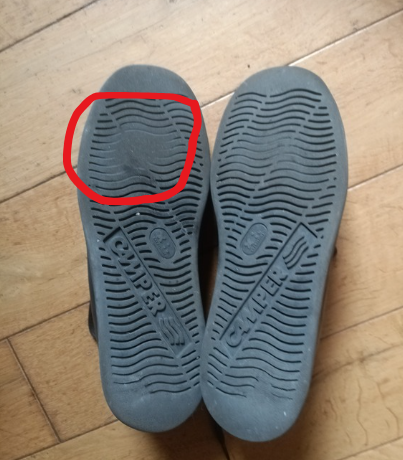
Another quick tell is an uneven wear pattern on the soles of their shoes. If you notice an obvious asymmetry in the wear pattern, this can be indicative of a leg length difference. Usually, more wear is seen at the front (forefoot) of the sole on the shorter leg side, as research has shown that more loading forces go through the forefoot on this side. However, this pattern doesn’t always hold true, and other problems can also give uneven wear.
The photo below is of the shoe soles from someone who has a shorter right leg (me). In my case, the wear pattern is as expected with more wear at the front of the right sole. Interestingly, my heel on the left shoe shows more wear, and although there’s no research supporting the idea, its often said (source ‘trust me bro’) that the shoe heel of the longer leg wears down more.
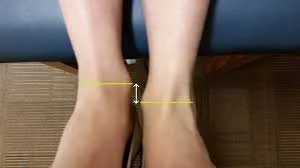
I also look at my patients laying on their backs with their legs flat and their feet together. I then slide my thumbs up the inside of their feet until I reach the bottom of their ankles. These points are officially known as the medial malleoli. If my thumbs are not level, then it’s a sign that there is a leg length difference present.
The photo below shows someone who has a shorter right leg. In this person the leg length difference is clearly visible, but if you slid your thumbs up the inside of their feet, they would end up at different levels where the yellow lines are.
So you have some asymmetries, what should you do?
As I said earlier, nobody is perfectly symmetrical, and if you are not experiencing any real issues with pain or mobility then you don’t really have to do anything. It might just be a case simply monitoring it and bearing it in mind should you develop any problems when you are older.
Having said that, being asymmetrical may lead to increased wear and tear in certain joints, particularly weight-bearing joints like the foot, knee and hip. This being the case, you might benefit from a consultation with an osteopath to see if they can help even you up.
If you’ve identified some asymmetry and you ARE experiencing problems, then it’s definitely worth getting your body properly evaluated by a specialist like an osteopath. As I mentioned earlier, asymmetries can sometimes be complicated as they can be caused by a number of different factors, often acting in concert. You should also remember that an asymmetry at the bottom of the body can sometimes cause issues at the top, in places like the shoulder and neck.
In the case of leg length differences caused by the pelvis being out of position, in my experience these often respond very well to osteopathy. Osteopaths can work on the hips, lumbar spine, and sacroiliac joints to help re-balance you.
If you have what is known as a structural leg length difference, where one of your legs is truly longer than the other, then these can often be successfully addressed by using inexpensive heel lifts (inside your shoe on the shorter leg side).
Correcting structural leg length differences with heel lifts is a bit of a dark art. People’s response to them varies a lot, and introducing them often involves a bit of trial and error getting the right thickness of heel lift. I usually start with a lift of no more than 3mm to 5mm.
What if you can’t get to an osteopath?
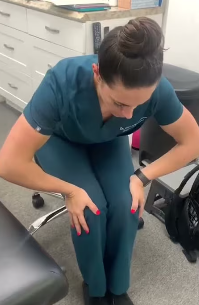
If you have a leg length difference which has been identified by checking at your ankles, then you can try the simple exercise shown below. Just click on the image for the video. Re-check at your ankles afterwards. Sometimes just doing this simple exercise can even you up, but usually only if your leg length difference is purely caused by your pelvis being slightly misaligned.
“Why are my legs different lengths?!
When someone has a leg length difference because one or more of the leg bones on one side is genuinely longer, the problem is referred to as ‘structural’ and it’s pretty obvious what’s going on.
The problem is, to definitively say a problem is structural, you would need to take a standing full length x-ray or MRI scan, and take precise leg measurements from the images, which means it’s seldom done. This means some degree of structural leg length difference may or may not be quietly lurking in the background of every problem.
However, in my experience most leg length differences appear to be as a result of the pelvis and legs not being positioned correctly, and as a result are amenable to correction, sometimes fully, other times partially. Such cases are called ‘functional’ leg length differences, and unfortunately nobody really knows for sure why they occur.
Researchers think they may be caused by the body adapting to ‘uneven habits’, otherwise known as ‘life’. My personal theory is that it mainly comes from habitually standing with more weight going through one leg. Over time this can lead to tight or overactive muscles on one side and weaker muscles on another side. It can also lead to joint stiffness, and small pelvic or spinal shifts. I’ve written about it before here.
Annoyingly, there doesn’t even seem to be a reliable connection between the leg you like to stand on , and the leg that becomes shorter. In my case I like to stand on my left leg mostly and my right leg is the shorter one. In other cases, the relationship is the other way around!
As you can see, a simple difference in your leg lengths can be very complicated and can upset the symmetry throughout your body. If you live near East Grinstead and think you have a leg length difference problem then come and see me.
Cliff Russell
Registered Osteopath @ Osteo Studio